
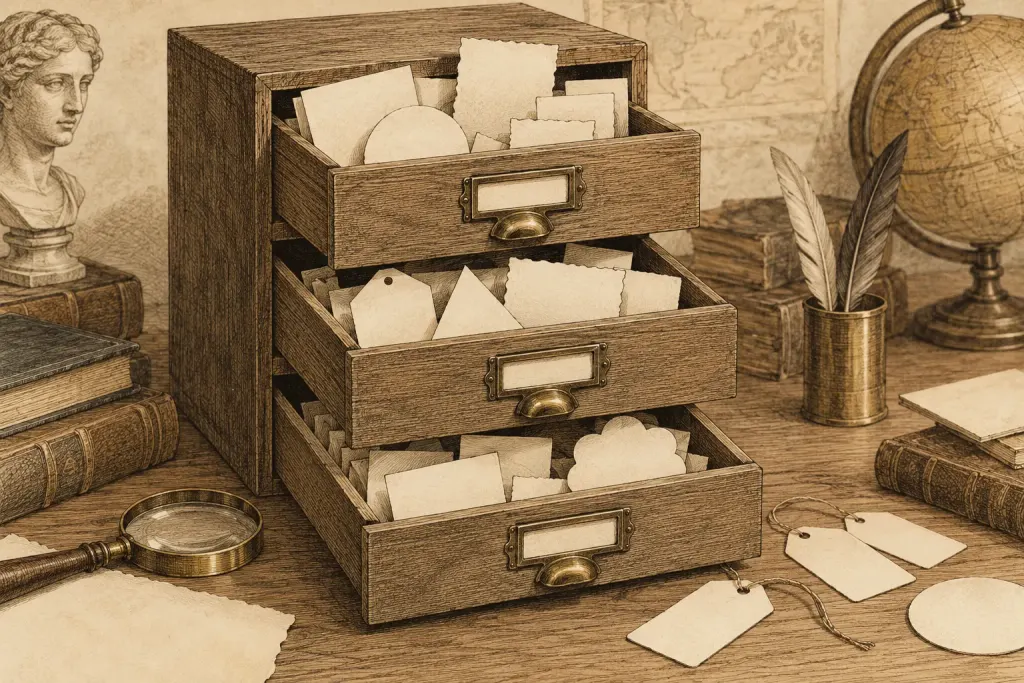
A broad label is a useful doorway. It gathers unfamiliar names into a subject you can begin to explore. Trouble starts when the doorway becomes the whole building: every text is assumed to say the same thing, every disagreement becomes an exception, and the label begins to do the reading for us.
Histories of religion and philosophy reward a slower approach. Keep the category, but make its boundaries visible.
Look for the writer’s definition
The introduction to Matthew Twigg’s 2015 Oxford doctoral thesis on the Nag Hammadi Apocalypse of Paul discusses disputes around the category “Gnosticism” and the varied material associated with it. It provides one example of a scholarly discussion about classification, rather than a warrant to treat all texts under that heading as a single creed.
When you meet a large category in a book or article, locate the definition before collecting conclusions. Does the writer identify a named community, a set of texts, a recurring idea, or a modern comparison? Those are different ways of grouping evidence, even when they share a familiar word.
Make the group small enough to inspect
Try replacing “they believed” in a note with something more specific: “this passage presents”, “this author argues”, or “this edition groups these works together”. If you cannot name the passage, author or collection, the statement may be wider than the evidence you have read.
This is a writing exercise, not a rule that broad interpretation is impossible. It helps reveal the point where a local observation turns into a general claim. That point deserves a reason.
Ask who supplied the name
Record whether the label comes from the people being studied, a contemporary observer, an opponent, a later editor or a modern researcher. If your source does not say, leave the origin unresolved. The important move is to ask, rather than infer identity from a heading.
Next, note what the classification helps you compare. Perhaps it highlights a shared image or a similar argument. Then ask what it leaves out: a difference in genre, audience, date, language or purpose. A category can be productive without accounting for every feature of its contents.
Carry a question into the next text
Instead of beginning with “How does this confirm the label?”, try “What does this particular text make difficult to summarise?” You might notice a change of speaker, an unexpected image or a passage that does not fit your first outline.
Keep those details. They are often where the next useful reading begins. Our guide to asking questions of primary sources offers a simple note-taking method for doing that.
Further reading: Matthew Twigg, Becoming Paul, Becoming Christ, Oxford DPhil thesis, 2015, especially its introductory discussion of classification. This article is a reading guide, not a review of the full thesis.