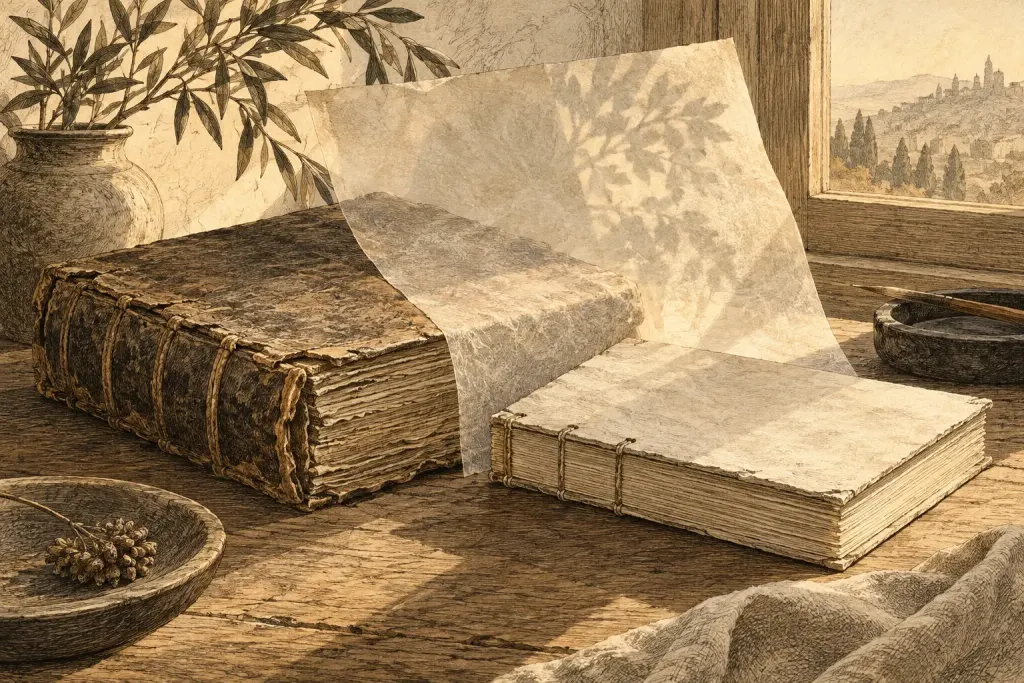
You open a catalogue and meet two dates: one for the work, another for the book in front of you. They may sit centuries apart. That gap is not necessarily a mistake. A text can keep being copied long after its first composition, and the surviving object belongs to a particular moment in that longer life.
A useful first question is therefore small and precise: what exactly does this date describe?
Give each date a job
On your reading notes, leave separate spaces for the proposed composition of a work, the production of the surviving copy, and the modern edition or translation you are using. Add a fourth space for uncertainty. A range such as “seventeenth or eighteenth century” should stay a range, rather than becoming a single convenient year.
Here is a fictional example. A catalogue dates a notebook to 1750, while an introduction argues that one poem copied inside it circulated earlier. The notebook date supports a claim about that object. By itself, it does not establish when the poem was first composed, who composed it, or how faithfully the notebook preserves an earlier version.
Sometimes the paper changes the story
In a 2016 Metropolitan Museum essay, Alzahraa K. Ahmed describes how watermarks helped identify Venetian paper from the seventeenth or eighteenth century in Coptic prayer and liturgical codices previously assigned much earlier dates. A colophon in one manuscript also says that it copies an earlier version. This is a case about the dating of Coptic Christian books, not evidence that those books are Gnostic.
The interesting reading habit is to notice what supplied the evidence: the material object and its accompanying statement. A page can look older than it is when a copying tradition preserves an earlier visual style.
Try a three-line catalogue note
Write “object”, “text” and “edition” on three separate lines. After each, record the date offered by your source and its stated basis. If the source says only “probably”, keep that word. If the composition date is absent, write “not established here”. An honest blank is more useful than a confident guess.
Then add the exact catalogue link or page reference. Later, when two authors seem to disagree, you can check whether they were dating the same thing at all.
This distinction also helps with reading primary sources critically. Age is one part of a document’s story; purpose, audience and transmission still need attention.
Read the case: Alzahraa K. Ahmed, Exploring Coptic Prayers Written on Venetian Paper, The Met, 2016.