
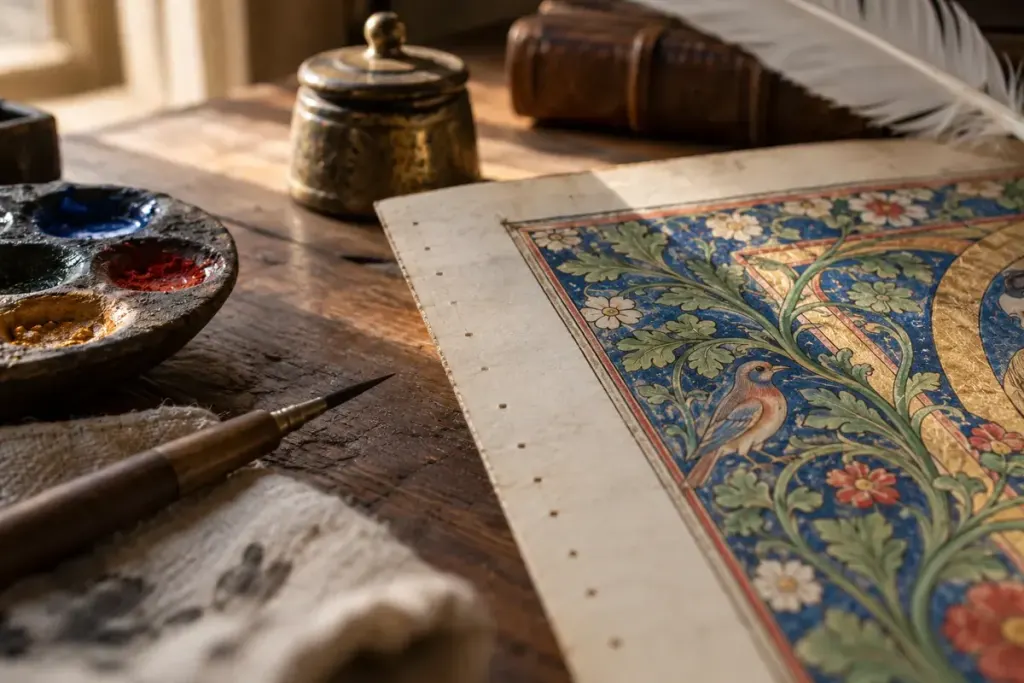
Tiny holes near a manuscript page’s edge can be easy to overlook or describe simply as damage. Some belong to the preparation of the writing area. Their interest lies in the relationship between a physical mark and the planned page.
Corpus Christi College Cambridge’s account of medieval manuscript making includes pricking and ruling among the preparation processes. On a clearly identified example, look for regular spacing and a relationship to the ruled lines rather than treating every hole as the same kind of evidence.
Use the catalogue’s identification where one exists. In a digital image, shadows, stains and compressed pixels may resemble openings. You should not diagnose the material from an unclear thumbnail or handle a fragile leaf to make the feature more obvious.
A trimmed edge may no longer preserve marks that were once present. An image may also crop them away. Write “not visible in this image” when that is all the evidence supports, rather than declaring that the manuscript was made without such preparation.
For a short notebook entry, record the folio, image identifier, edge examined and the feature’s relation to the writing lines. Add the source of any technical identification. The result connects the finished text with the work of arranging its surface, without turning a few small holes into an unsupported reconstruction of the entire workshop.
AI-generated editorial illustration; not a documentary photograph.